Posted on

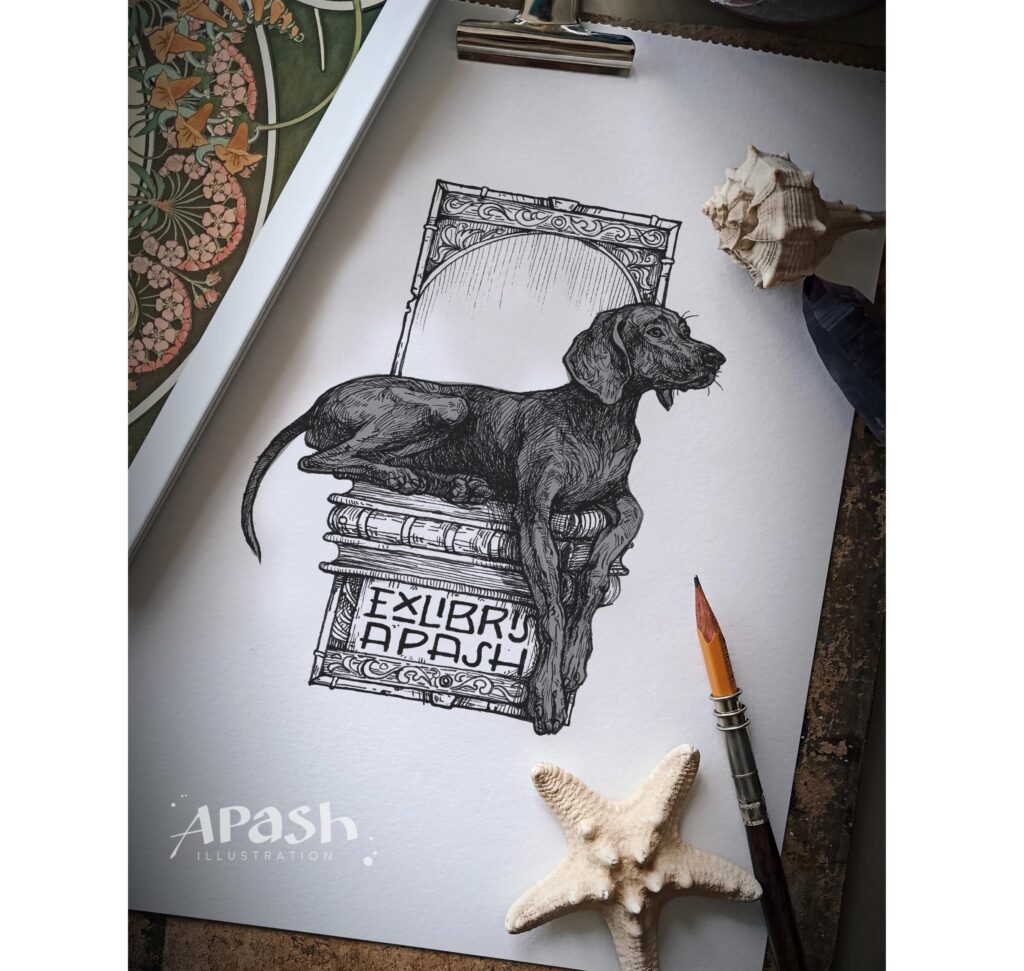
Ex Libris – from the Library of APASH

What is an Ex Libris?

An Ex Libris (from the Latin ex libris—“from the books of” or “from the library of”) is a small mark of ownership traditionally placed on the inside cover of a book. It can be a stamp, a sticker, or a graphic label featuring the owner’s name or initials, their coat of arms, a symbol, or an image related to their personality and interests.

But an Ex Libris is much more than a mark that says, “This book is mine.”

A Brief History of Ex Libris

The tradition of Ex Libris originated in Europe during the 15th century, shortly after the invention of the printing press. At that time, books were rare and valuable items, owned primarily by wealthy individuals, religious institutions, and libraries.

One of the oldest known Ex Libris was created around 1450–1480 for the German nobleman Hans Knabensberg, known by the nickname “Iglers.” It is a small print that indicates the book’s belonging to his library.

Initially, ex libris served a purely practical function—to indicate the book’s owner and to protect valuable volumes from being lost or misappropriated. Over time, however, these small marks began to reveal much more about their owners.

They began to feature coats of arms, initials, animals, plants, mythological figures, and various symbols related to the owner’s life, profession, interests, or character.

Thus, the Ex Libris gradually evolved into a small form of graphic art—a unique personal portrait condensed into a single image.

Ex Libris Today

Today, an Ex Libris is no longer a necessity in the traditional sense. Instead, it has become a personal mark and a small work of art, adding a unique touch to a book collection and making a library feel even more personal.

An Ex Libris does more than simply identify the owner of a book — it tells a story about them, reflecting their personality, passions, and interests.

My Ex Libris

For the SoEXHIBITION ARDA exhibition, I had the pleasure of creating my own Ex Libris for my personal book collection.

Of course, it had to feature Arda, my beloved black dog, who is a constant presence in both my life and many of my illustrations.

For me, this is the true essence of an Ex Libris: creating a small, distinctive mark that is deeply personal and uniquely yours.

What Would Your Ex Libris Look Like?

It could feature your favourite animal, a plant, a special place, an object, a symbol, or something entirely personal. You don’t even need to have a clear idea to begin with — we can explore possibilities together and turn them into an original, one-of-a-kind illustration.

If you’d like an Ex Libris of your own for your personal library, you can commission a custom illustration here:

Posted on

How do you draw a dream?

Perhaps painting dreams is a dangerous pursuit. It materializes internal, subconscious, and deeply personal processes and makes them visible, real, and accessible at any moment. It is uncertain how this would play out, but I will take the risk nonetheless.

A materialized picture of an inner affirmation, a locked moment.

And how do you draw a dream?

First, you take the images from the dream and its idea. You find similar real objects as images in combination with your imagination and develop the composition. The drawing cannot be exactly the same as in the dream, but it can still resemble the feeling that the dream brought.

I recently dreamed of an owl, bright, almost white, and behind it, crows, black as night, perched on something like an arch. I interpret the symbols of what I saw – the crows, part of the inner “shadows” – fear, shame, anger, pride, and sadness, and the owl in the foreground symbolizes wisdom, light, and the displacement of the darkness of inner turmoil.

WORK IN PROGRESS…

(to be continued)

The result of painting dreams… you feel the reality of the illusion. You find yourself somewhere between them.

It turned out to be a prelude to my next book, “Chasing Shadows.” I don’t know if it will be part of it, time will tell. I’m starting again, and it will be a while before I finish it.

© APASH illustration 2025

Posted on

2025 Upcoming MARKETS and EVENTS

22 May / 05 June – BIRDS memo GAME – exhibition and presentation at Fox Book Cafe, Sofia

11 / 25 September – BIRDS memo GAME – exhibition and presentation in the BSPB Shop, Sofia, Str. Kosta Lulchev 10 Sofia

18-21 September – КAPANA FEST, Plovdiv

12-14 December – Christmas Bazaar Mish Mash Fest in Largo, Sofia

Posted on

African Flower Beetle I work in process

The African Flower Beetle (Mecynorhina ugandensis) is a strikingly colorful and vibrant member of the large beetle family. I have illustrated its body with deep green color and with wide  spread wings reflecting the colors of their surroundings.
Males can reach up to 85 mm, while females grow to about 60 mm in length.

I love watching how beetles take flight revealing delicate, perfectly folded wings that tuck back seamlessly when they land.

This beetle belongs to the subfamily Cetoniinae, tribe Goliathini, and was first described by Julius Moser in 1907. As its name suggests, it is native to Uganda, but it can also be found in neighboring regions of the Democratic Republic of the Congo in Africa.

Technique: pencil and aquarelle
Size: 15 /15 cm

(Quoted information from Wikipedia.)

Posted on

Frequently Asked Questions

Can you draw my dog?

Yes, I m drawing custom pets portraits. Explore detailed information on this page.

You can also send me a request at : illustration.apash@gmail.com

Can you draw my dog on a mug/ bag / postcard?

Once you have ordered your pet’s bespoke portrait, you could have his image printed on a mug , bag, card or other media. I do not paint directly on mugs, textiles or other surfaces.

Can you paint me and my dog?

I specialize in painting animals so I do not include human figures in the portraits.

Where can I buy your stuff from?

On this page you can see the location of all the physical stores that offer my products. On my Facebook page I announce the events and bazaars I take part in. All available products are offered through the shop on my website.

What is Facsimile?

Facsimile / Facsimile / is a copy or reproduction of old books, manuscripts, maps or art prints as close to the original as possible.

In the case of my paintings, they are digitally printed copies of my original illustrations, often with hand added detail and color. The shape and paper are the same or as close as possible to the original. Each facsimile is hand signed. The print run is organic from 50 to 100 copies.

Posted on — 1 Comment

Agami heron | Work in process

The agami heron (Agamia agami) is a medium-sized heron. It is a resident breeding bird from Central America south to Peru and Brazil. It is sometimes known as the chestnut-bellied heron, and is the only member of the genus Agamia. In Brazil it is sometimes called Soco beija-flor, meaning ‘hummingbird heron’, thanks to its unique coloration pattern.

The agami heron is listed as vulnerable by the IUCN, due to predictions of future habitat destruction within its range.

This uncommon species is 66–76 centimetres (26–30 inches) in length. It is short-legged for a heron, and has a thin bill which is considerably longer than the head. The neck and underparts are chestnut, with a white line down the centre of the foreneck, and the wings are shiny green. Wispy pale blue feathers decorate the crown, sides of the foreneck, and lower back. The legs, bill, and bare facial patch are dull yellow. During the breeding season the facial patch can change color to reddish. The sexes are similar, but juveniles are largely brown above with a white foreneck, and streaked brown-and-white underparts. The normal clutch size is two blue eggs.

Картинката не може да има празен alt атрибут; името на файла е Agami_Heron_Agamia_agami-APASH-illustration-Anelia-Pashova-pencil-work-in-process-1.jpg

After developing the pencil drawing with 2B, 3B pencil, I used the strong watercolor tones of the German Schminke. For some of the feathers I used a little white tempera paint Talens.

Картинката не може да има празен alt атрибут; името на файла е Agami-heron-apash-illustration-facebook.jpg
Картинката не може да има празен alt атрибут; името на файла е Agami_Heron_Agamia_agami-APASH-illustration-Anelia-Pashova-2022-SMALL.jpg
Posted on — Leave a comment

Exhibition Sketchbooks ( 2014-2021 ) – APASH illustration

Known for her animalistic passion for illustration, in this exhibition APASH will show you a different side of her work. Sketchbooks is a personal exhibition that contains over 40 selected moments from the illustrator’s sketches. For the past 7 years in more than 20 drawing diaries are preserved memories of travels, quiet moments, people met by chance and non-accidental personalities, exquisite creatures and found thoughts. Going through the technique of pencil and fine pen, the living line of her drawing sparingly builds memorable shape and volume.

Картинката не може да има празен alt атрибут; името на файла е plami.jpg

APASH illustartion is the creative pseudonym of the artist Anelia Pashova. She has a master’s degree from the National Academy of Arts in Sofia, majoring in Illustration and is a member of DAFNI / Society of Animalists, Florists and Scientific Illustrators /. He has published five books, two of which are copyrighted. As a freelance artist, he developed his own brand of products with animalistic drawings.

In order not to violate the integrity of the sketches, the paintings in the exhibition are copies of the originals. On site at GIFTED, you will be able to purchase paintings from the limited series. All are numbered and manually signed by the author.

Картинката не може да има празен alt атрибут; името на файла е Sketchbooks-2014-2021-APASH-illustration-1-Gifted-Sofia-2-32-1024x856.jpg
Картинката не може да има празен alt атрибут; името на файла е Sketchbooks-2014-2021-APASH-illustration-1-Gifted-Sofia-1024x768.jpg


The exhibition can be viewed until June 15, 2021 at Gifted Sofia
Sofia, 24 Ivan Denkoglu Str
Working hours: 10.30 – 19.30
Facebook event

Картинката не може да има празен alt атрибут; името на файла е frida-apash-sketchbook.jpg